Self-study Curriculum
My goal is to be able to leverage insights from existing research to develop innovative solutions to complex problems and transform them into production-ready systems that deliver real-world value. I believe that a deep and comprehensive understanding of AI, computer science, and mathematics is essential to achieving this.
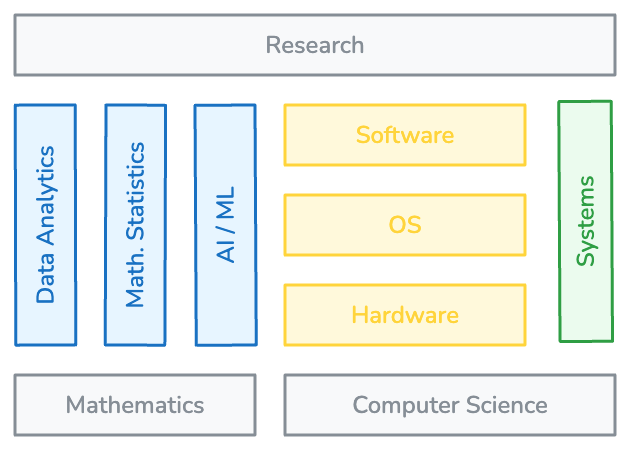
Figure 1 provides an overview of the relationships between the different areas. Traditional Data Science topics are shown in blue. The development and operation of information systems are represented in green, while the technological foundations required for implementing both AI methods and information systems are shown in yellow. All areas build upon the foundations of mathematics and computer science and are complemented by research literacy as an overarching competency.
My approach to building this expertise combines studying textbooks and literature with hands-on, project-based work. Below, you’ll find a list of resources I have used and plan to use. Please note that this list is not exhaustive and may evolve over time.
Artifical Intelligence
- Wolf, A. (2022). Machine Learning Simplified: A gentle introduction to supervised learning.
- Harvard University. (2020). CS50’s Introduction to Artificial Intelligence with Python. Structure and content closely based on Artificial Intelligence: A Modern Appoach by Russell & Norvig.
- Karpathy, A. (2022). Neural Networks: Zero to Hero.
- Sutton, R. S., & Barto, A. (2020). Reinforcement Learning: An Introduction. Possible accompanying course: DeepMind x UCL | Deep Learning Lecture Series.
Computer Science
- Matthes, E. (2019). Python Crash Course: A Hands-On, Project-Based Introduction to Programming.
- Percival, H., & Gregory, B. (2020). Architecture Patterns with Python: Enabling Test-Driven Development, Domain-Driven Design, and Event-Driven Microservices.
- Kleppmann, M., & Riccomini, C. (2026). Designing Data-Intensive Applications: The Big Ideas Behind Reliable, Scalable, and Maintainable Systems.
- Huyen, C. (2022). Designing Machine Learning Systems: An Iterative Process for Production-Ready Applications.
- Nisan, N. & Schocken, S. (2021). The Elements of Computing Systems: Building a Modern Computer from First Principles with accompanying courses: Nand To Tetris Part I & II.
- Bryant, R. E., & O’Hallaron, D. (2016). Computer Systems: A Programmer’s Perspective. Possible accompanying course: Introduction to Computer Systems; requires knowledge of C.
- Massachusetts Institute of Technology. (2020). The Missing Semester of Your CS Education.
Mathematics
- Epp, S. (2020). Discrete Mathematics with Applications.
- Lial, M. L., Hornsby, J., Schneider, D. I., & Daniels, C. J. (2017). College Algebra & Trigonometry.
- Deisenroth, M. P., Faisal, A. A., & Ong, C. S. (2020). Mathematics for Machine Learning.
- James, G. et al. (2017). An Introduction to Statistical Learning.
- Bärtl, M. (2017). Statistik Schritt für Schritt.
Research & Writing
- Schimel, J. (2012). Writing Science: How to Write Papers That Get Cited and Proposals That Get Funded.
- Wördenweber, M. (2019). Leitfaden für wissenschaftliche Arbeiten.
- Frank, A. et al. (2013). Schlüsselkompetenzen: Schreiben in Studium und Beruf.